
Measuring Bilingual Marketing ROI | ABE Media
Prove the value of your Hispanic marketing investment. Learn attribution models, KPIs, and reporting frameworks for bilingual campaign measurement.
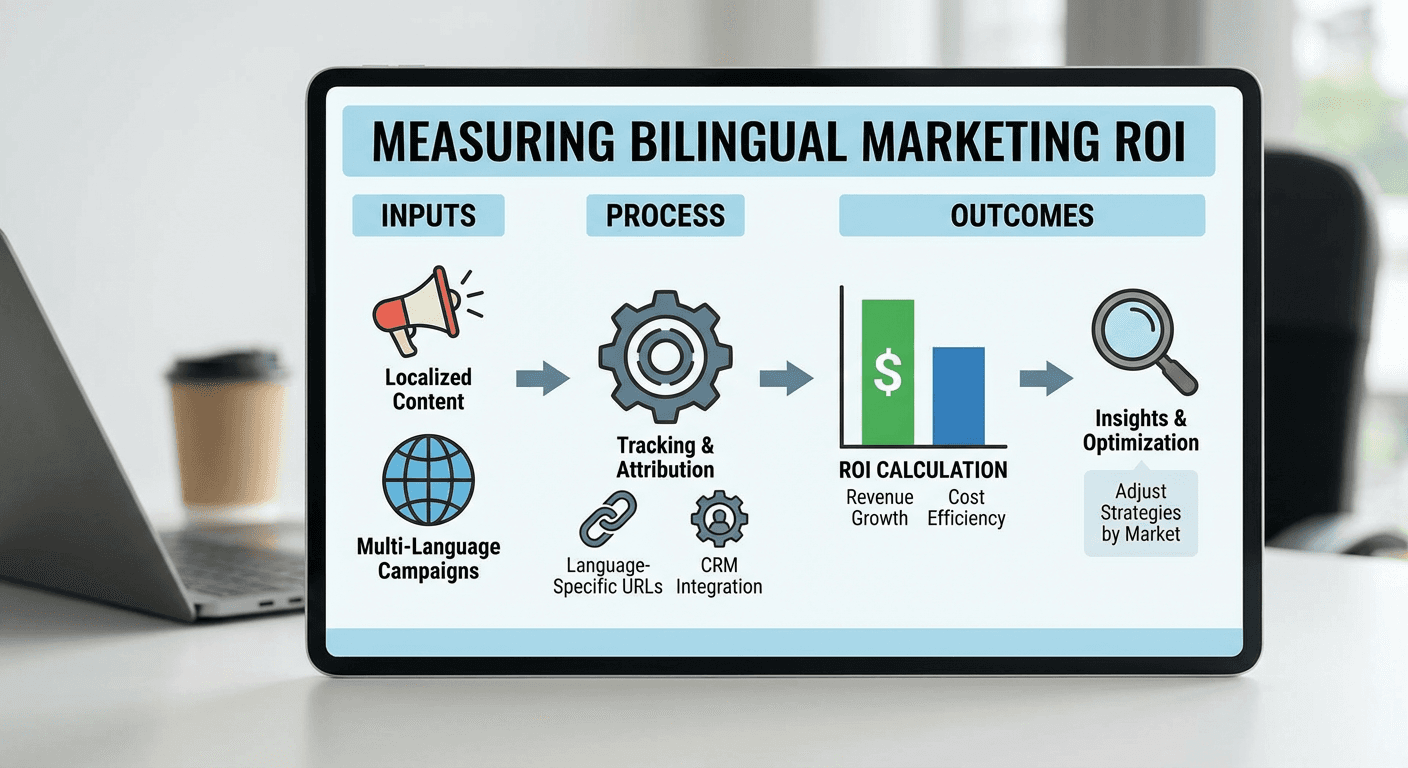
Bilingual marketing programs often struggle to secure budget because organizations can't clearly demonstrate return on investment. When Hispanic marketing results blend into general metrics, the specific value of Spanish-language initiatives becomes invisible—making it difficult to justify continued or expanded investment. Proper bilingual marketing measurement requires isolating Hispanic audience performance, tracking language-specific customer journeys, and building attribution models that capture how Spanish marketing contributes to business outcomes. This guide provides frameworks for measuring and communicating bilingual marketing ROI, helping you prove value and secure resources for Hispanic market growth.
1The Bilingual Measurement Challenge
Standard marketing measurement systems create blind spots for bilingual programs. When Spanish campaigns drive awareness that converts through English touchpoints, attribution models may credit English marketing while Spanish investment appears ineffective. Hispanic customers who research in Spanish but purchase in English disappear from Spanish ROI calculations. Language preference isn't consistently captured across touchpoints, making customer journey analysis by language impossible. Brand lift among Hispanic audiences goes unmeasured when research panels underrepresent Spanish speakers. These measurement gaps cause bilingual marketing to appear less effective than it actually is, threatening program budgets and limiting Hispanic market investment.
2Building Language-Aware Tracking Infrastructure
Effective bilingual measurement starts with tracking infrastructure that captures language throughout the customer journey. Implement language detection and preference capture at every touchpoint: website visits, form submissions, email engagement, chat interactions, and purchase transactions. Use UTM parameters that identify Spanish campaign sources distinctly from English. Configure analytics segments that isolate Spanish-language traffic and engagement. Ensure CRM records maintain language preference as a core customer attribute that flows through all systems. Build conversion tracking that attributes by language, including phone call tracking with language identification. Create customer IDs that enable cross-device, cross-language journey analysis. This infrastructure enables the measurement that proves bilingual marketing value.
3Attribution Models for Bilingual Marketing
Standard last-click attribution systematically undervalues Spanish marketing that often appears earlier in customer journeys. Implement multi-touch attribution that credits Spanish touchpoints appropriately when they contribute to conversions completed in English. Consider time-decay models that weight Spanish awareness activities fairly. Build custom attribution models based on actual Hispanic customer journey analysis. Track view-through conversions from Spanish display and video campaigns. Analyze assisted conversions where Spanish marketing contributes without being final touchpoint. For sophisticated measurement, implement incrementality testing that isolates Spanish marketing contribution through controlled experiments. The right attribution model reveals Spanish marketing's true contribution to business outcomes.
4Key Performance Indicators by Language
Track KPIs separately for English and Spanish to understand relative performance and identify optimization opportunities. Awareness metrics: Spanish reach, impressions, and brand search volume growth. Engagement metrics: Spanish content consumption, email engagement, and social interaction by language. Conversion metrics: leads, sales, and revenue attributed to Spanish marketing. Efficiency metrics: cost per Spanish lead, Spanish customer acquisition cost, and Spanish ROAS. Lifetime value: Hispanic customer retention, repeat purchase rates, and referral generation. Compare metrics between languages to identify where Spanish performs better or worse than English, informing optimization priorities. Set Spanish-specific targets based on Hispanic market opportunity rather than simply matching English benchmarks.
5Hispanic Market Research Integration
Supplement behavioral metrics with Hispanic market research that captures outcomes quantitative data misses. Brand tracking studies should include Spanish-speaking respondent samples adequate to measure Hispanic brand awareness, consideration, and preference changes. Customer satisfaction research should segment by language preference to identify Hispanic experience quality. Include Hispanic focus groups in creative and campaign testing to optimize Spanish marketing effectiveness. Survey Hispanic customers about how they discovered your brand to inform attribution models. Measure Hispanic Net Promoter Score separately to understand loyalty within this segment. This research layer provides context that explains quantitative trends and guides strategic decisions.
6Reporting and Stakeholder Communication
Build reports that clearly communicate bilingual marketing value to stakeholders. Create executive dashboards showing Spanish marketing contribution to business outcomes alongside English performance. Calculate and present Spanish marketing ROI using consistent methodology that accounts for full-funnel contribution. Highlight Spanish marketing efficiency advantages: lower CPCs, lower CAC, or stronger engagement rates versus English where they exist. Present Hispanic market growth trends that demonstrate opportunity scale. Include case studies showing specific Spanish marketing successes. Address measurement limitations transparently while explaining how methodology captures Spanish contribution accurately. Regular reporting cadence maintains visibility for bilingual marketing value. ABE Media helps businesses implement measurement frameworks that prove bilingual marketing ROI and secure resources for Hispanic market growth.
Key Takeaway
Proving bilingual marketing ROI requires intentional measurement infrastructure and appropriate analytical frameworks—you cannot demonstrate Spanish marketing value with systems designed only for English campaigns. By capturing language throughout customer journeys, implementing fair attribution models, tracking language-specific KPIs, and integrating market research, businesses can finally show the true contribution of Hispanic marketing investment. This measurement capability protects bilingual marketing budgets, informs optimization decisions, and builds the case for expanded Hispanic market investment. Make measurement a priority to ensure your bilingual marketing receives the resources its performance deserves.
Related Topics
Continue Reading
Bilingual Customer Journey Mapping Guide | ABE Media
Map customer journeys across English and Spanish touchpoints. Learn to identify language moments, optimize bilingual experiences, and eliminate friction.
Hispanic MarketHispanic Market Research Methods & Best Practices | ABE Media
Research Hispanic consumers effectively with proven methodologies. Learn qualitative, quantitative, and cultural research approaches for Latino markets.
Bilingual AdvertisingBilingual Email Marketing Automation Guide | ABE Media
Automate email campaigns in English and Spanish. Learn segmentation, personalization, and automation workflows for bilingual audiences.
Need help measuring your Hispanic marketing ROI?
Let us help you with your bilingual advertising project. Our team of experts is ready to bring your vision to life.